TutorialDay 006Model compression7 steps~4 minOnly needs ÷ and round
Quantisation, by hand
Store six weights in 4 bits, measure the error, then add one outlier.
Read the slides as text 7 slides
Slide 1
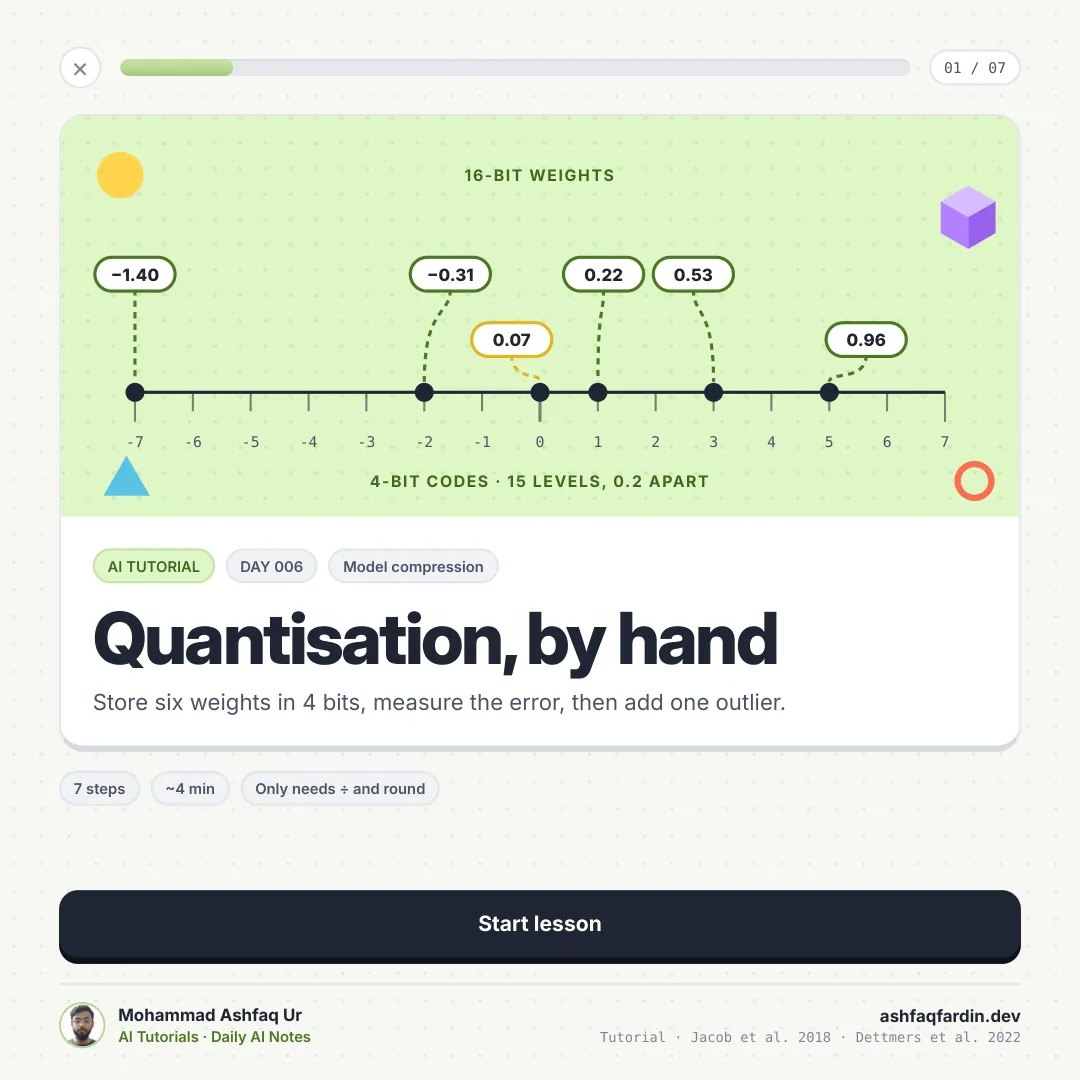
Quantisation, by hand
Store six weights in 4 bits, measure the error, then add one outlier.
7 steps
~4 min
Only needs ÷ and round
Slide 2 · THE BIG PICTURE
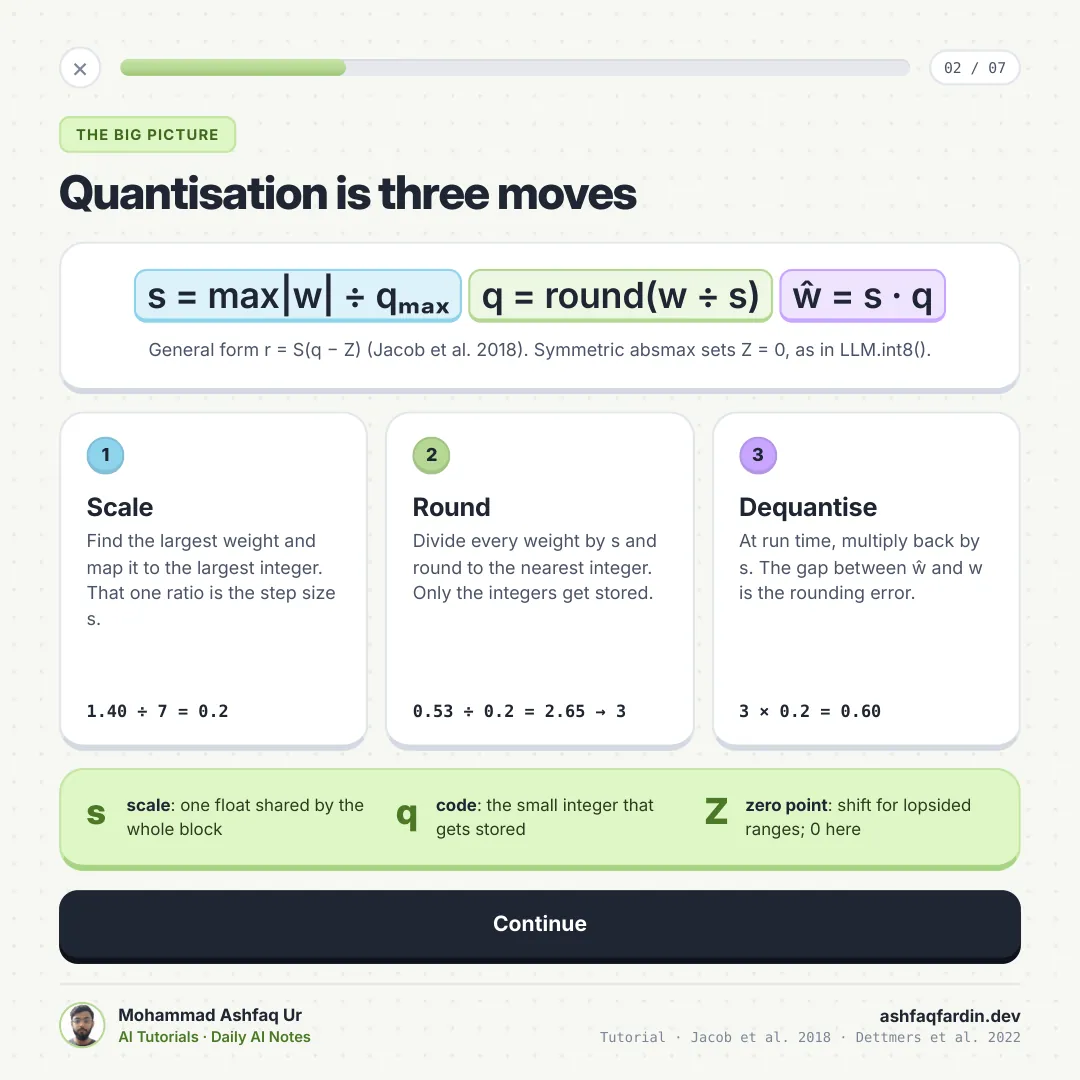
Quantisation is three moves
s = max|w| ÷ qₘₐₓ q = round(w ÷ s) ŵ = s · q
General form r = S(q − Z) (Jacob et al. 2018). Symmetric absmax sets Z = 0, as in LLM.int8().
1. Scale
Find the largest weight and map it to the largest integer. That one ratio is the step size s.
1.40 ÷ 7 = 0.2
2. Round
Divide every weight by s and round to the nearest integer. Only the integers get stored.
0.53 ÷ 0.2 = 2.65 → 3
3. Dequantise
At run time, multiply back by s. The gap between ŵ and w is the rounding error.
3 × 0.2 = 0.60
s scale: one float shared by the whole block
q code: the small integer that gets stored
Z zero point: shift for lopsided ranges; 0 here
Slide 3 · STEP 1 · SCALE
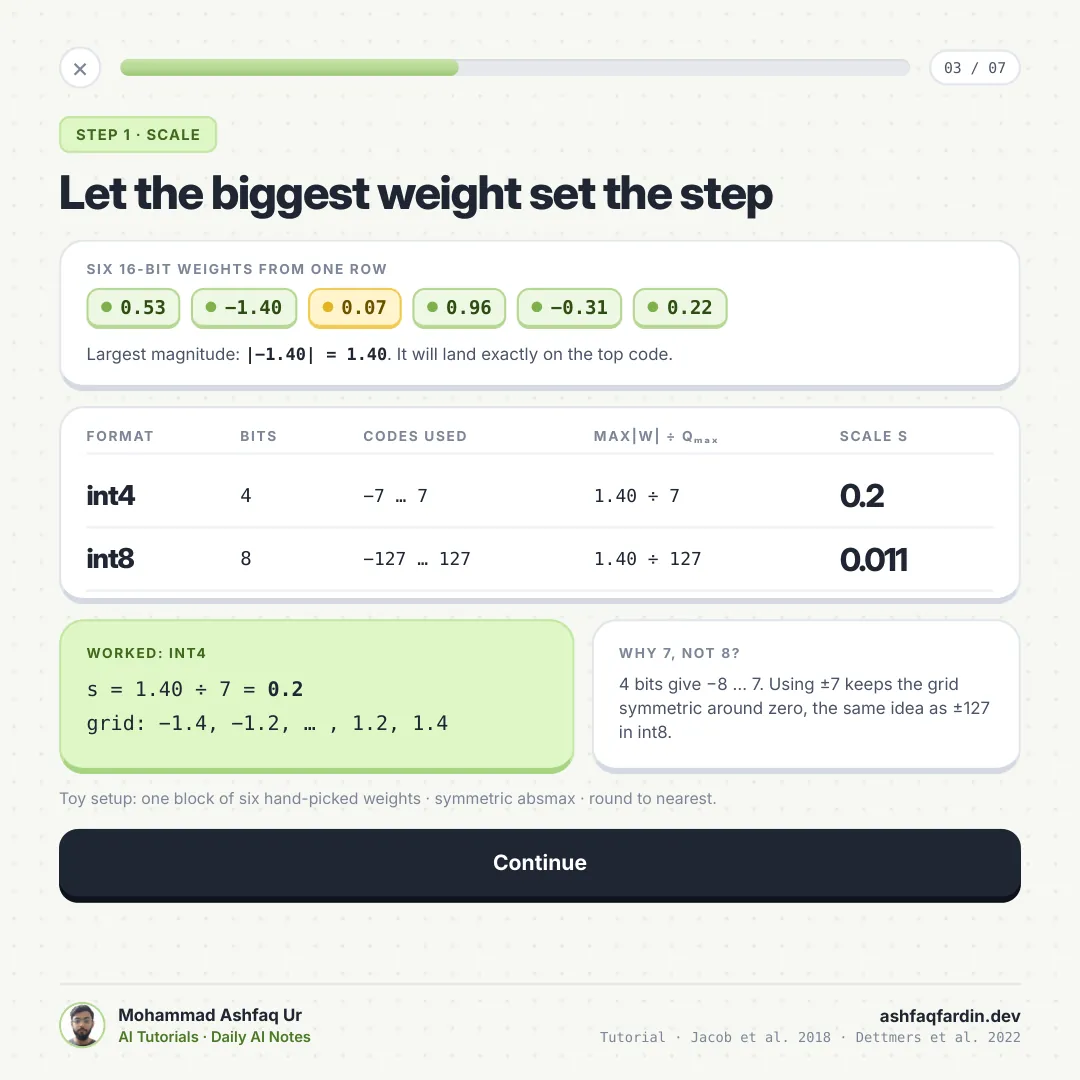
Let the biggest weight set the step
Toy setup: one block of six hand-picked weights · symmetric absmax · round to nearest.
SIX 16-BIT WEIGHTS FROM ONE ROW
0.53 −1.40 0.07 0.96 −0.31 0.22
Largest magnitude: |−1.40| = 1.40. It will land exactly on the top code.
| FORMAT | BITS | CODES USED | MAX|W| ÷ Qₘₐₓ | SCALE S |
|---|---|---|---|---|
| int4 | 4 | −7 … 7 | 1.40 ÷ 7 | 0.2 |
| int8 | 8 | −127 … 127 | 1.40 ÷ 127 | 0.011 |
WORKED: INT4
s = 1.40 ÷ 7 = 0.2
grid: −1.4, −1.2, … , 1.2, 1.4WHY 7, NOT 8?
4 bits give −8 … 7. Using ±7 keeps the grid symmetric around zero, the same idea as ±127 in int8.
Slide 4 · STEP 2 · ROUND
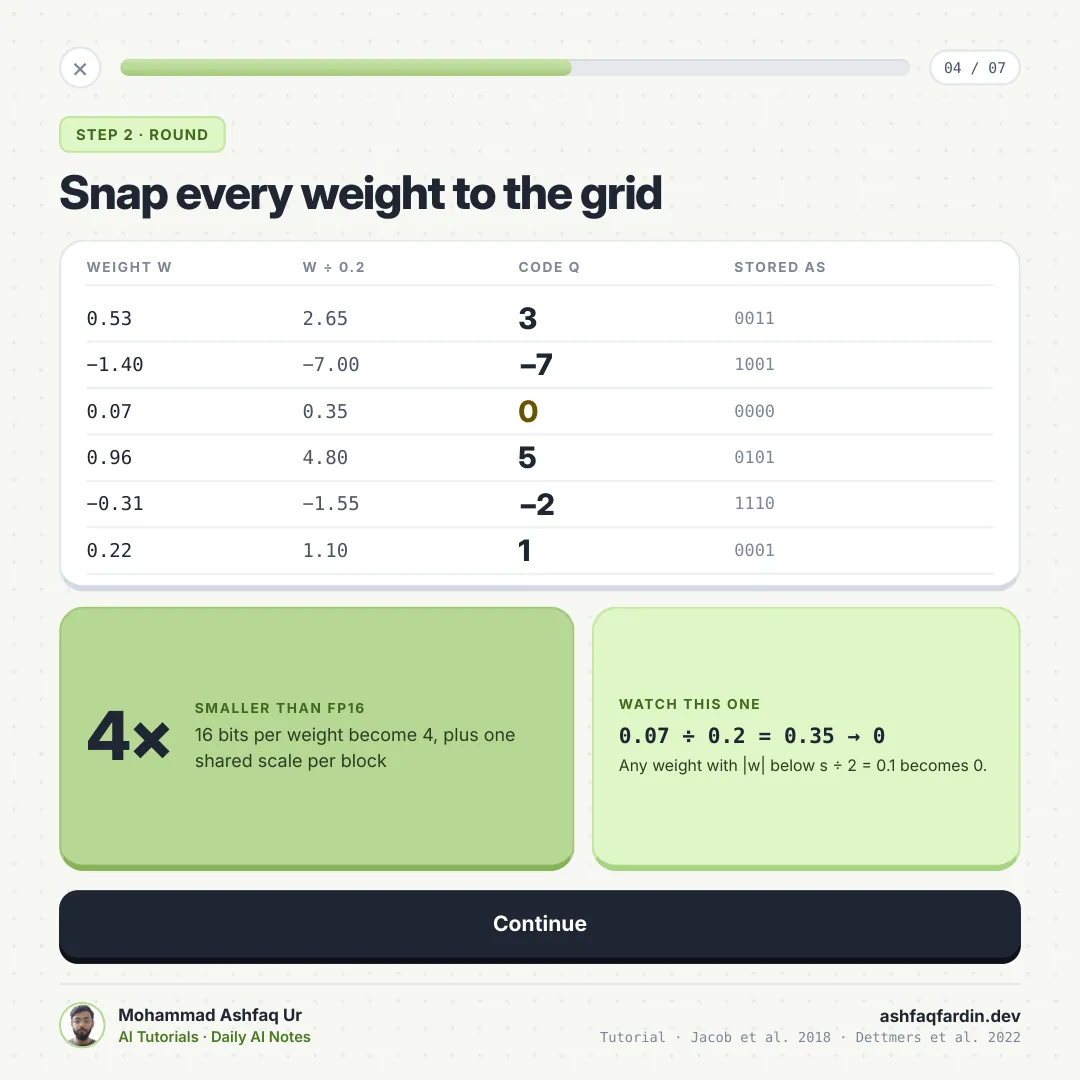
Snap every weight to the grid
| WEIGHT W | W ÷ 0.2 | CODE Q | STORED AS |
|---|---|---|---|
| 0.53 | 2.65 | 3 | 0011 |
| −1.40 | −7.00 | −7 | 1001 |
| 0.07 | 0.35 | 0 | 0000 |
| 0.96 | 4.80 | 5 | 0101 |
| −0.31 | −1.55 | −2 | 1110 |
| 0.22 | 1.10 | 1 | 0001 |
4×
SMALLER THAN FP16
16 bits per weight become 4, plus one shared scale per block
WATCH THIS ONE
0.07 ÷ 0.2 = 0.35 → 0
Any weight with |w| below s ÷ 2 = 0.1 becomes 0.
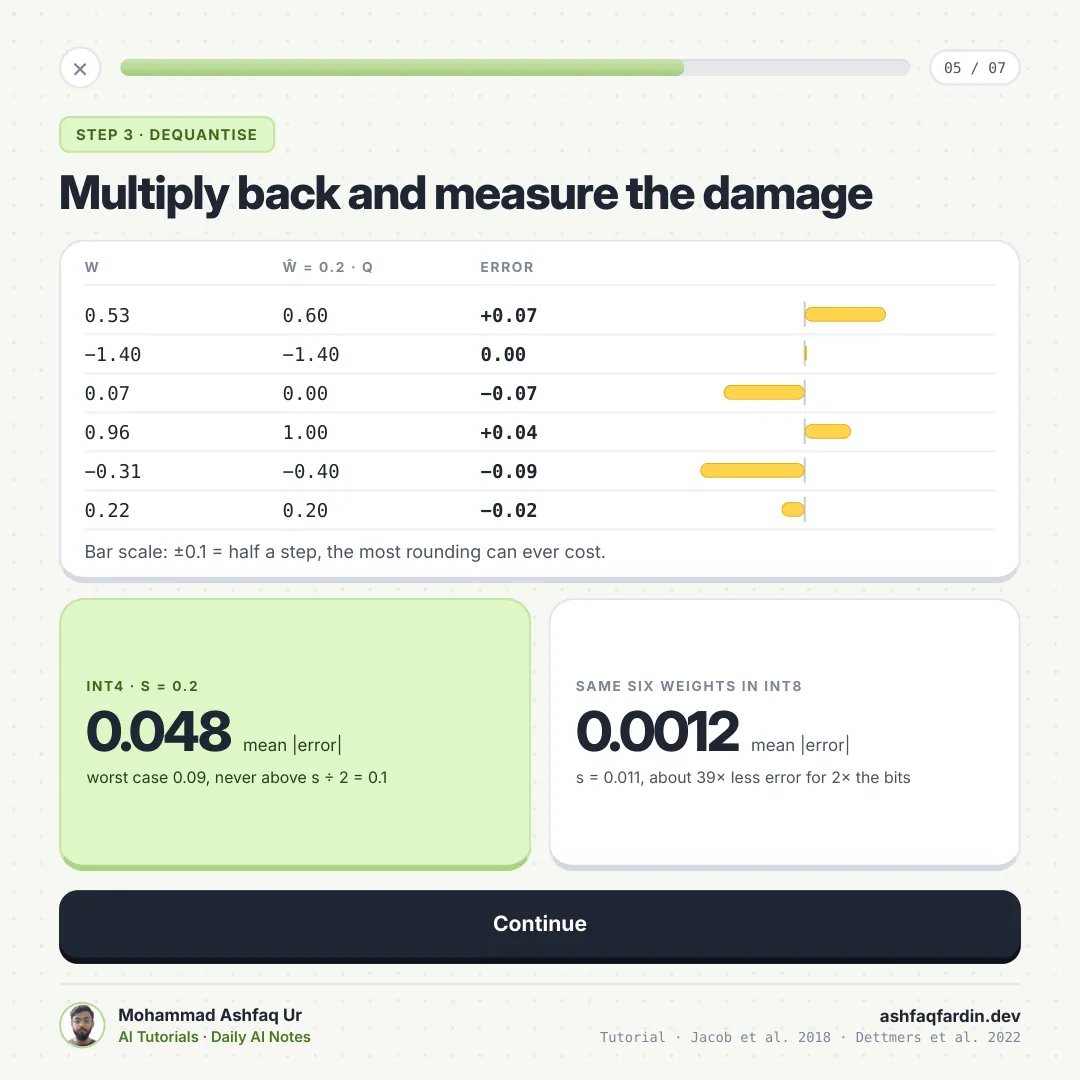
Slide 5 · STEP 3 · DEQUANTISE
Multiply back and measure the damage
| W | Ŵ = 0.2 · Q | ERROR |
|---|---|---|
| 0.53 | 0.60 | +0.07 |
| −1.40 | −1.40 | 0.00 |
| 0.07 | 0.00 | −0.07 |
| 0.96 | 1.00 | +0.04 |
| −0.31 | −0.40 | −0.09 |
| 0.22 | 0.20 | −0.02 |
Bar scale: ±0.1 = half a step, the most rounding can ever cost.
INT4 · S = 0.2
0.048 mean |error|
worst case 0.09, never above s ÷ 2 = 0.1
SAME SIX WEIGHTS IN INT8
0.0012 mean |error|
s = 0.011, about 39× less error for 2× the bits
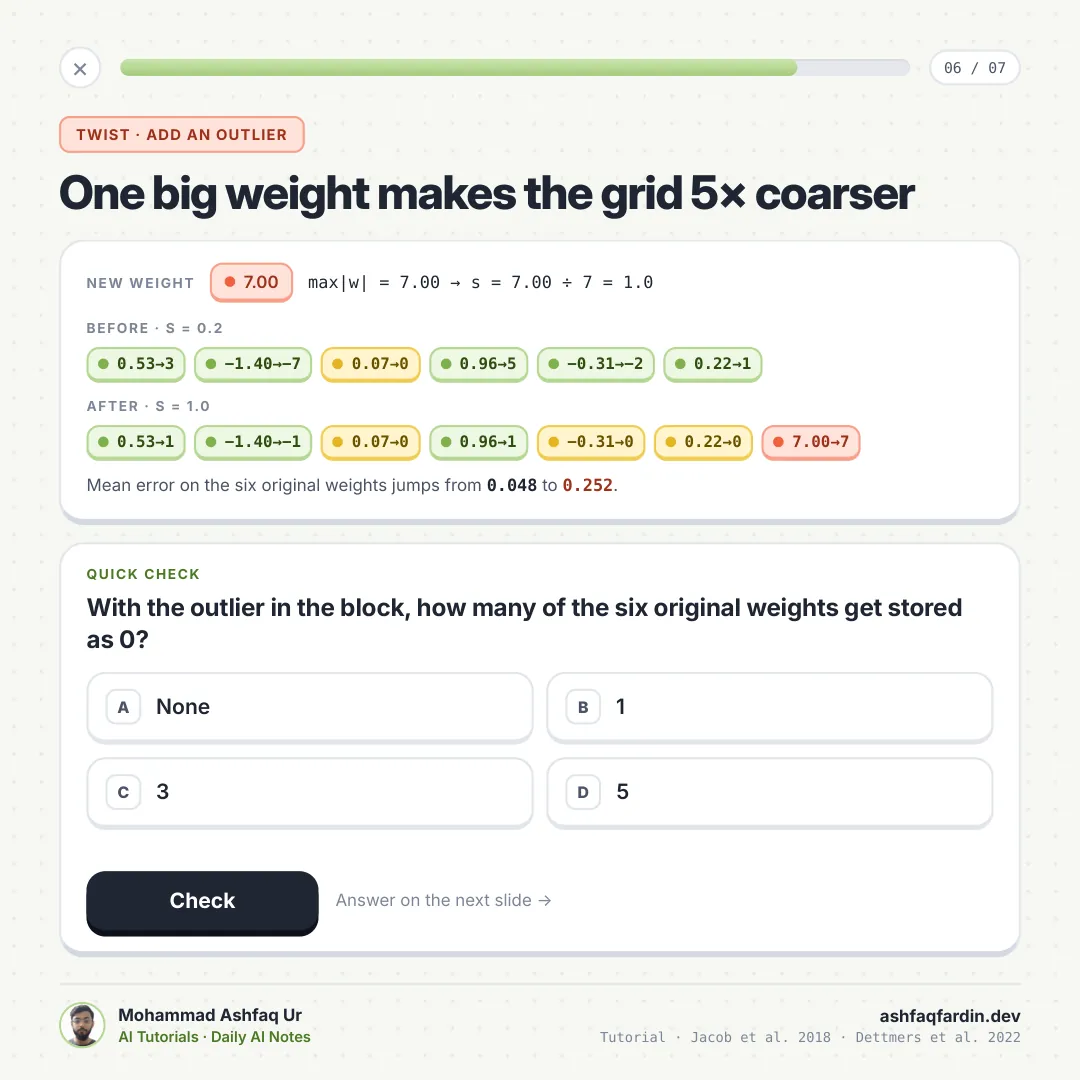
Slide 6 · TWIST · ADD AN OUTLIER
One big weight makes the grid 5× coarser
NEW WEIGHT 7.00 max|w| = 7.00 → s = 7.00 ÷ 7 = 1.0
BEFORE · S = 0.2
0.53→3 −1.40→−7 0.07→0 0.96→5 −0.31→−2 0.22→1
AFTER · S = 1.0
0.53→1 −1.40→−1 0.07→0 0.96→1 −0.31→0 0.22→0 7.00→7
Mean error on the six original weights jumps from 0.048 to 0.252.
QUICK CHECK
With the outlier in the block, how many of the six original weights get stored as 0?
- A. None
- B. 1
- C. 3
- D. 5
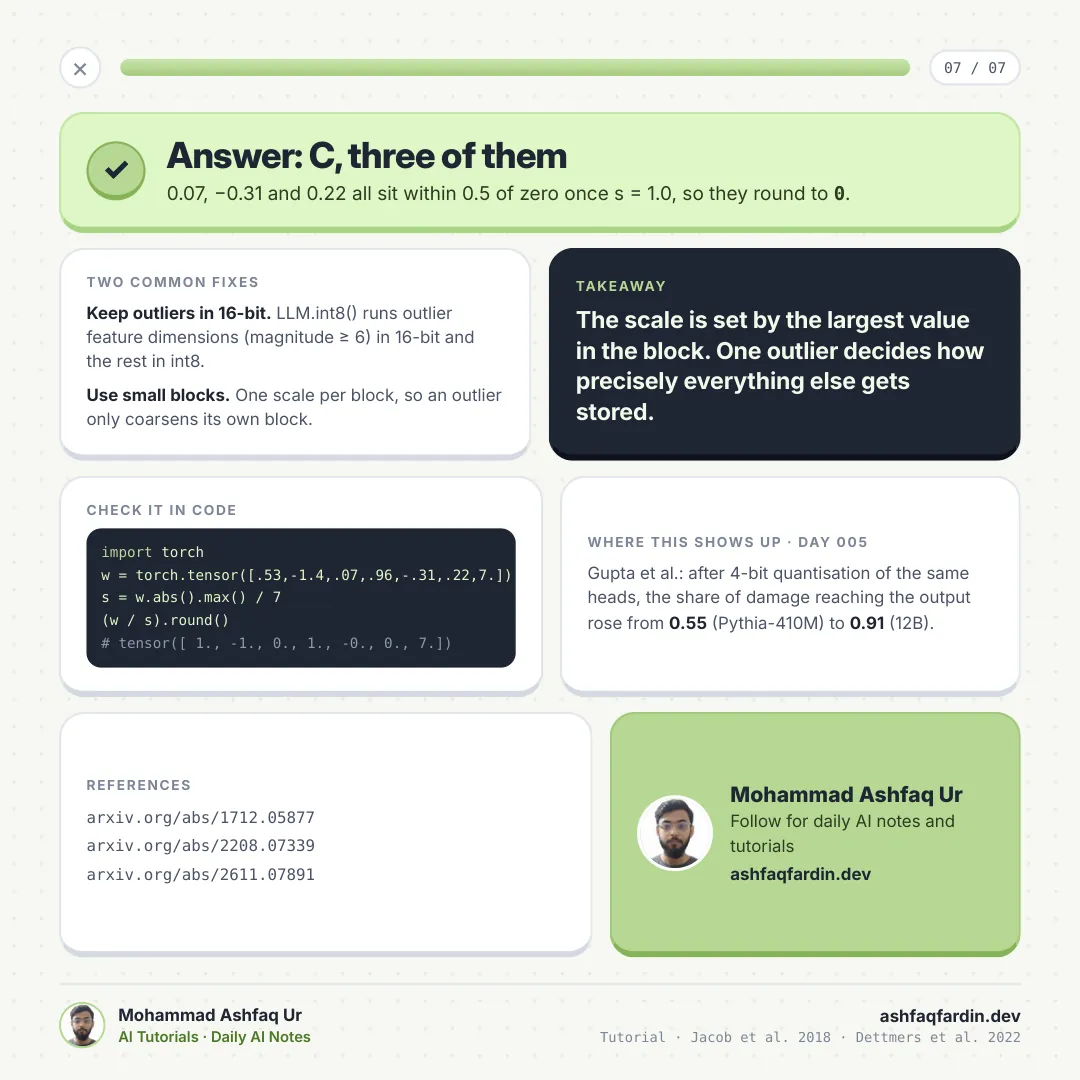
Slide 7
Answer: C, three of them
0.07, −0.31 and 0.22 all sit within 0.5 of zero once s = 1.0, so they round to 0.
TWO COMMON FIXES
Keep outliers in 16-bit. LLM.int8() runs outlier feature dimensions (magnitude ≥ 6) in 16-bit and the rest in int8.
Use small blocks. One scale per block, so an outlier only coarsens its own block.
TAKEAWAY
The scale is set by the largest value in the block. One outlier decides how precisely everything else gets stored.
CHECK IT IN CODE
import torch
w = torch.tensor([.53,-1.4,.07,.96,-.31,.22,7.])
s = w.abs().max() / 7
(w / s).round()
# tensor([ 1., -1., 0., 1., -0., 0., 7.])WHERE THIS SHOWS UP · DAY 005
Gupta et al.: after 4-bit quantisation of the same heads, the share of damage reaching the output rose from 0.55 (Pythia-410M) to 0.91 (12B).
REFERENCES
arxiv.org/abs/1712.05877
arxiv.org/abs/2208.07339
arxiv.org/abs/2611.07891