AI SAFETYDATA CURATION
Your fine-tuning data can make a model less safe without a single harmful example.
Judge data by how it changes the model, not by what it says.
Read the slides as text 6 slides
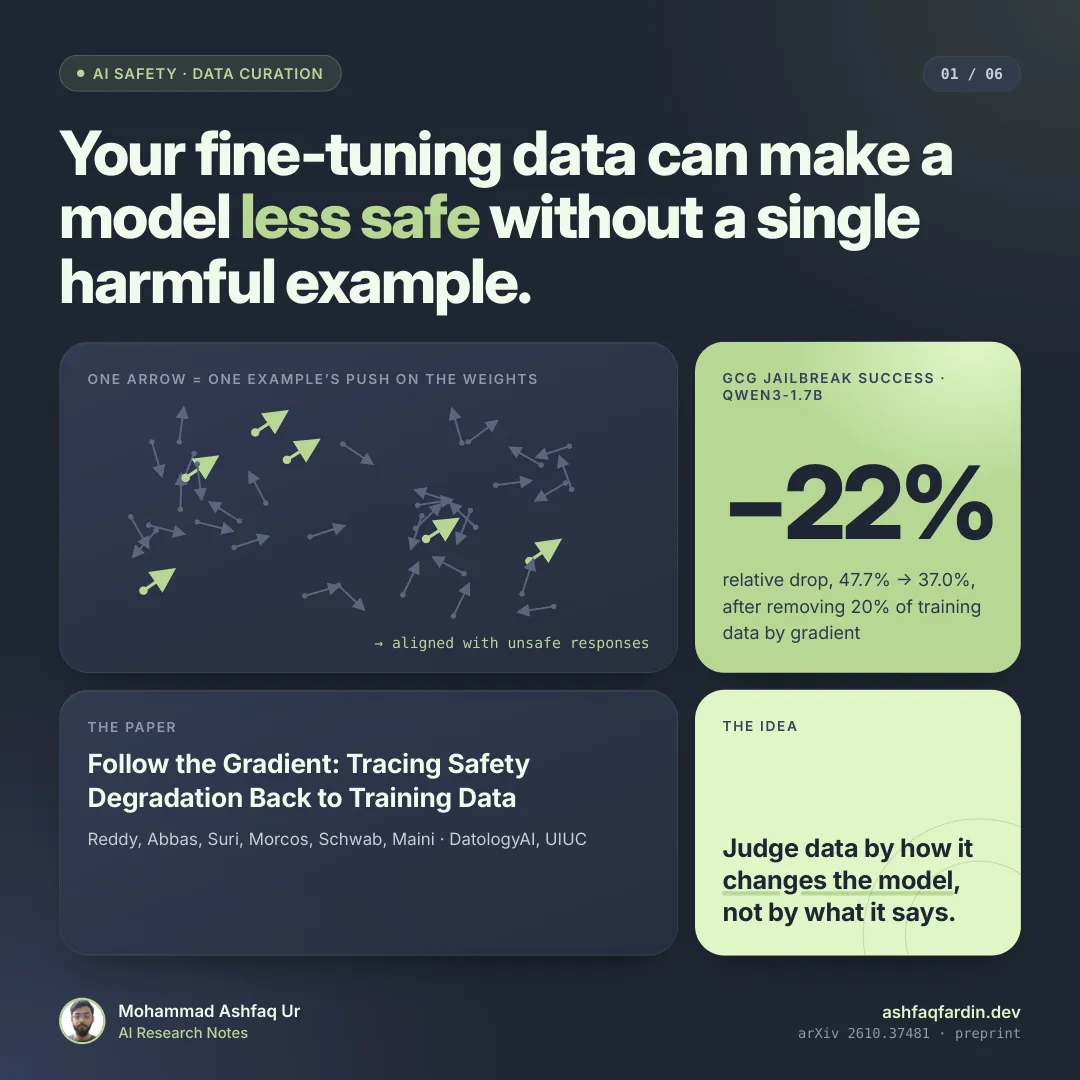
Slide 1 · AI SAFETY · DATA CURATION
Your fine-tuning data can make a model less safe without a single harmful example.
ONE ARROW = ONE EXAMPLE’S PUSH ON THE WEIGHTS
→ aligned with unsafe responses
GCG JAILBREAK SUCCESS · QWEN3-1.7B
−22%
relative drop, 47.7% → 37.0%, after removing 20% of training data by gradient
THE PAPER
Follow the Gradient: Tracing Safety Degradation Back to Training Data
Reddy, Abbas, Suri, Morcos, Schwab, Maini · DatologyAI, UIUC
THE IDEA
Judge data by how it changes the model, not by what it says.
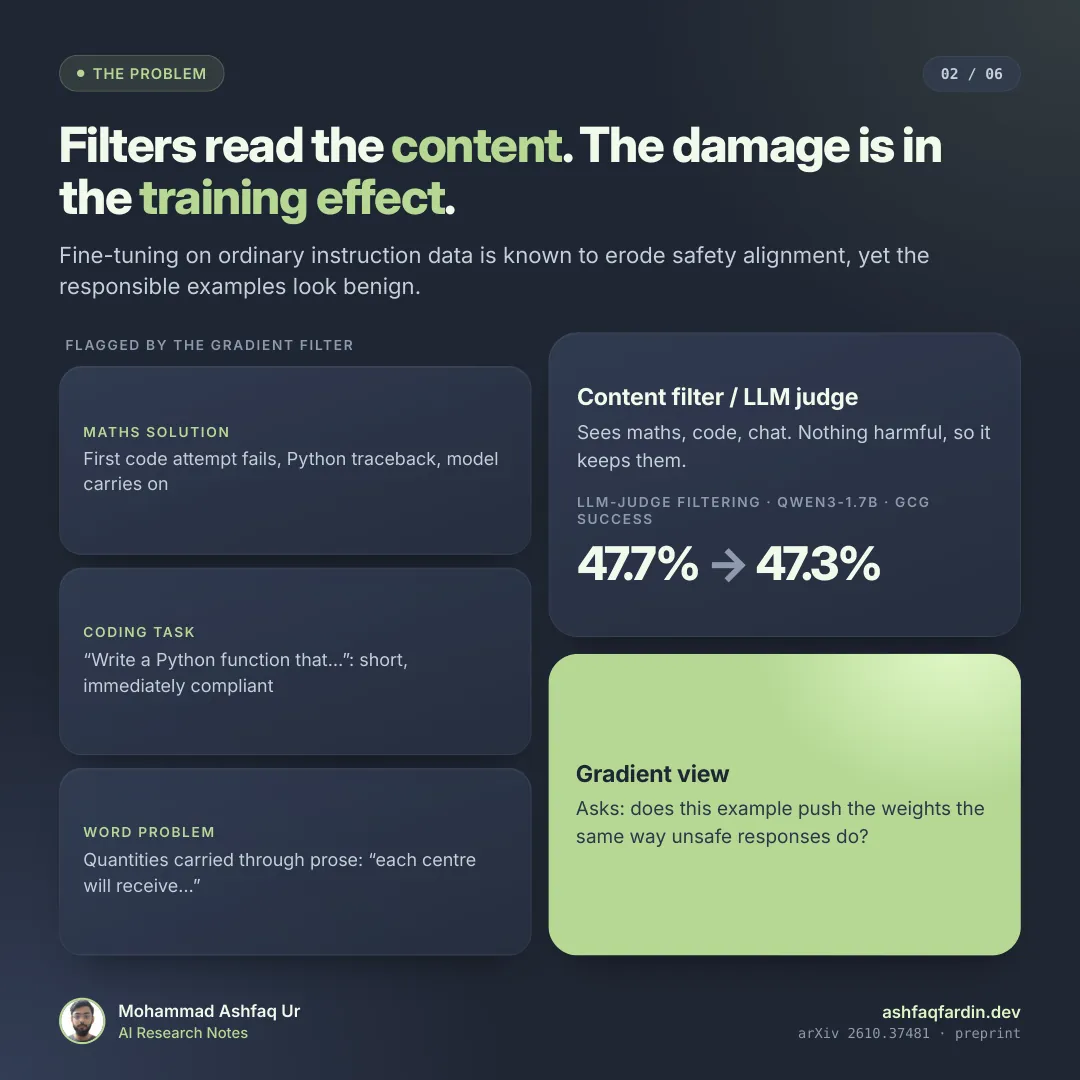
Slide 2 · THE PROBLEM
Filters read the content. The damage is in the training effect.
Fine-tuning on ordinary instruction data is known to erode safety alignment, yet the responsible examples look benign.
FLAGGED BY THE GRADIENT FILTER
MATHS SOLUTION
First code attempt fails, Python traceback, model carries on
CODING TASK
“Write a Python function that…”: short, immediately compliant
WORD PROBLEM
Quantities carried through prose: “each centre will receive…”
Content filter / LLM judge
Sees maths, code, chat. Nothing harmful, so it keeps them.
LLM-JUDGE FILTERING · QWEN3-1.7B · GCG SUCCESS
47.7% → 47.3% Gradient view
Asks: does this example push the weights the same way unsafe responses do?
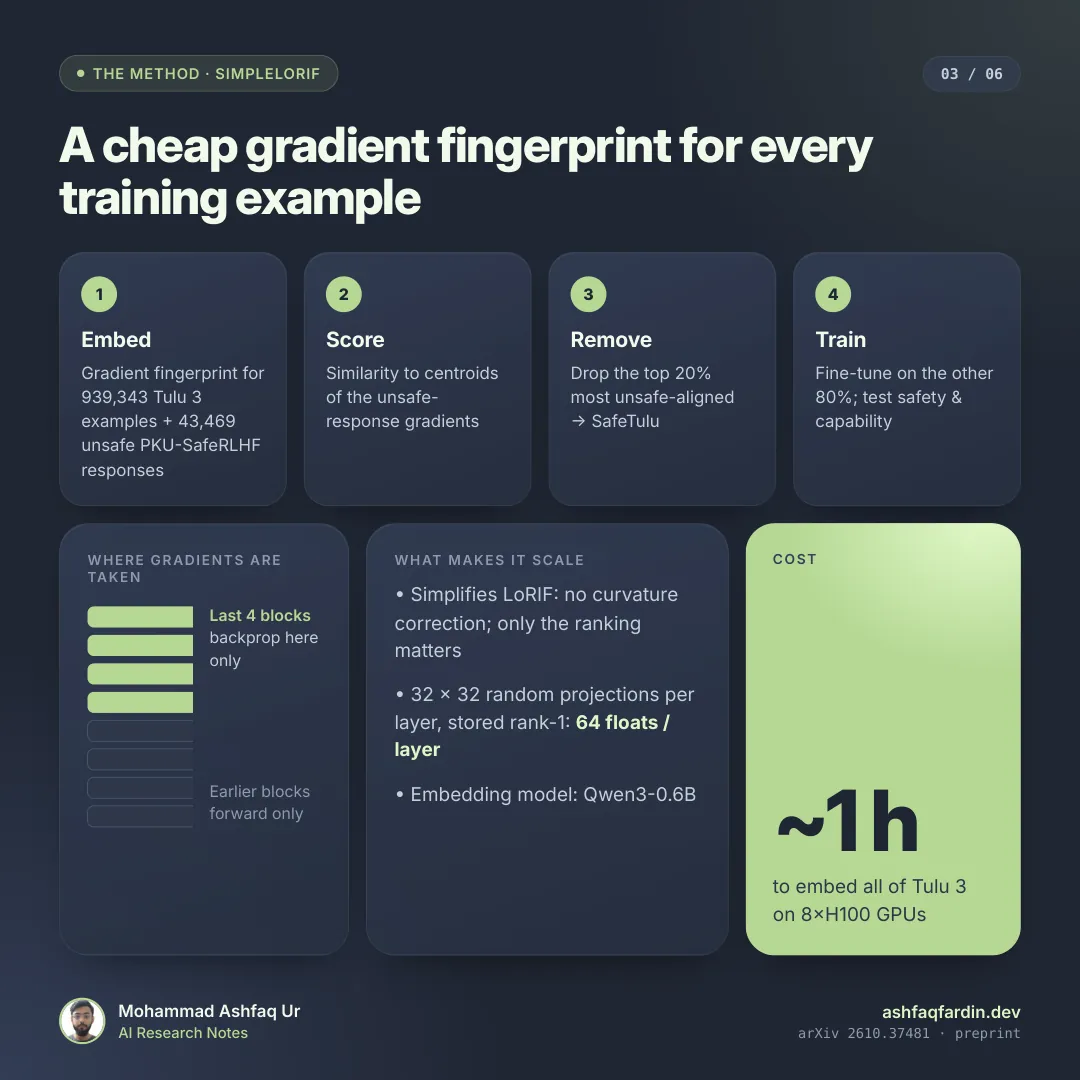
Slide 3 · THE METHOD · SIMPLELORIF
A cheap gradient fingerprint for every training example
1 Embed
Gradient fingerprint for 939,343 Tulu 3 examples + 43,469 unsafe PKU-SafeRLHF responses
2 Score
Similarity to centroids of the unsafe- response gradients
3 Remove
Drop the top 20% most unsafe-aligned → SafeTulu
4 Train
Fine-tune on the other 80%; test safety & capability
WHERE GRADIENTS ARE TAKEN
Last 4 blocks backprop here only
Earlier blocks forward only
WHAT MAKES IT SCALE
• Simplifies LoRIF: no curvature correction; only the ranking matters
• 32 × 32 random projections per layer, stored rank-1: 64 floats / layer
• Embedding model: Qwen3-0.6B
COST
~1 h
to embed all of Tulu 3 on 8×H100 GPUs
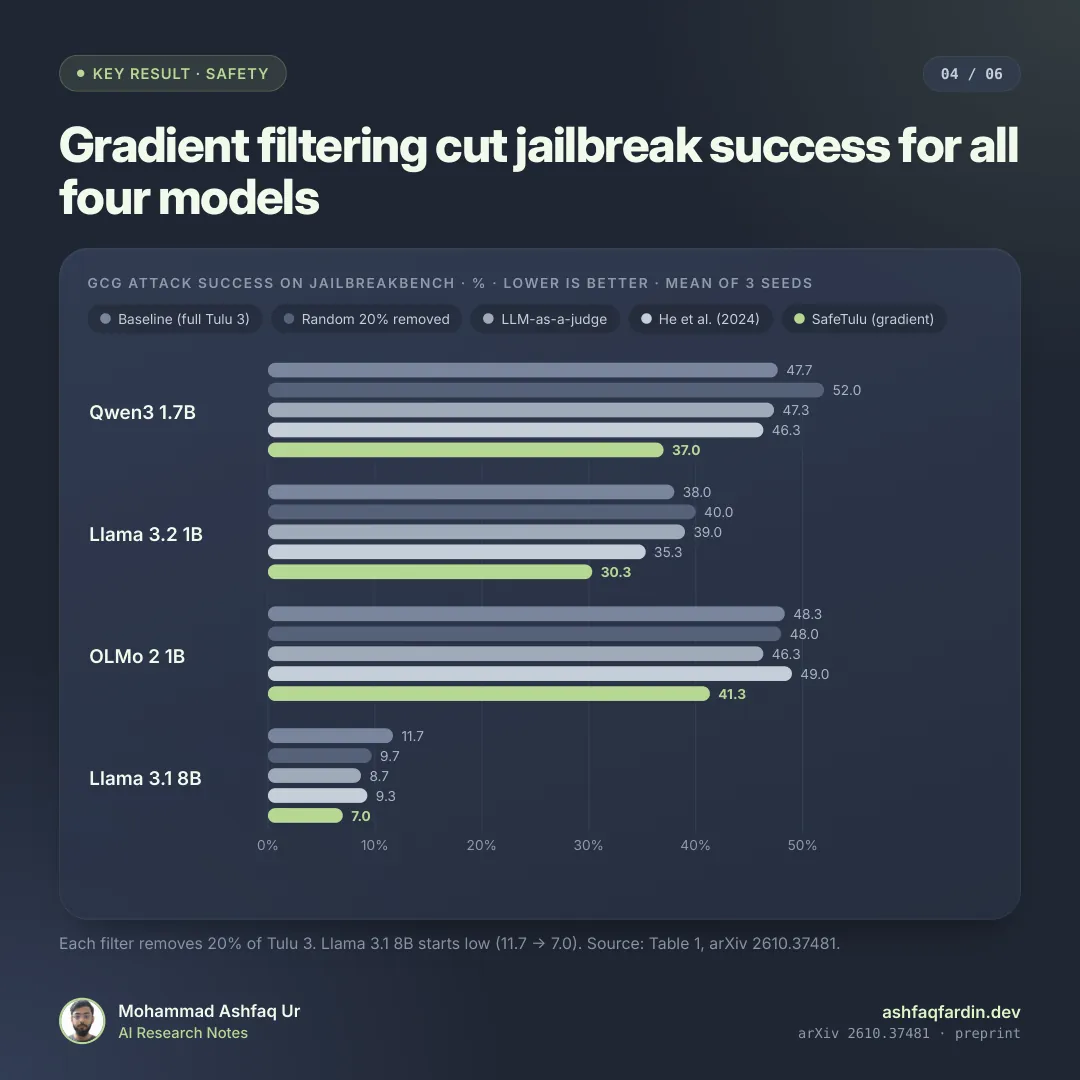
Slide 4 · KEY RESULT · SAFETY
Gradient filtering cut jailbreak success for all four models
Each filter removes 20% of Tulu 3. Llama 3.1 8B starts low (11.7 → 7.0). Source: Table 1, arXiv 2610.37481.
GCG ATTACK SUCCESS ON JAILBREAKBENCH · % · LOWER IS BETTER · MEAN OF 3 SEEDS
Baseline (full Tulu 3)
Random 20% removed
LLM-as-a-judge
He et al. (2024)
SafeTulu (gradient)
0% 10% 20% 30% 40% 50% Qwen3 1.7B 47.7 52.0 47.3 46.3 37.0 Llama 3.2 1B 38.0 40.0 39.0 35.3 30.3 OLMo 2 1B 48.3 48.0 46.3 49.0 41.3 Llama 3.1 8B 11.7 9.7 8.7 9.3 7.0
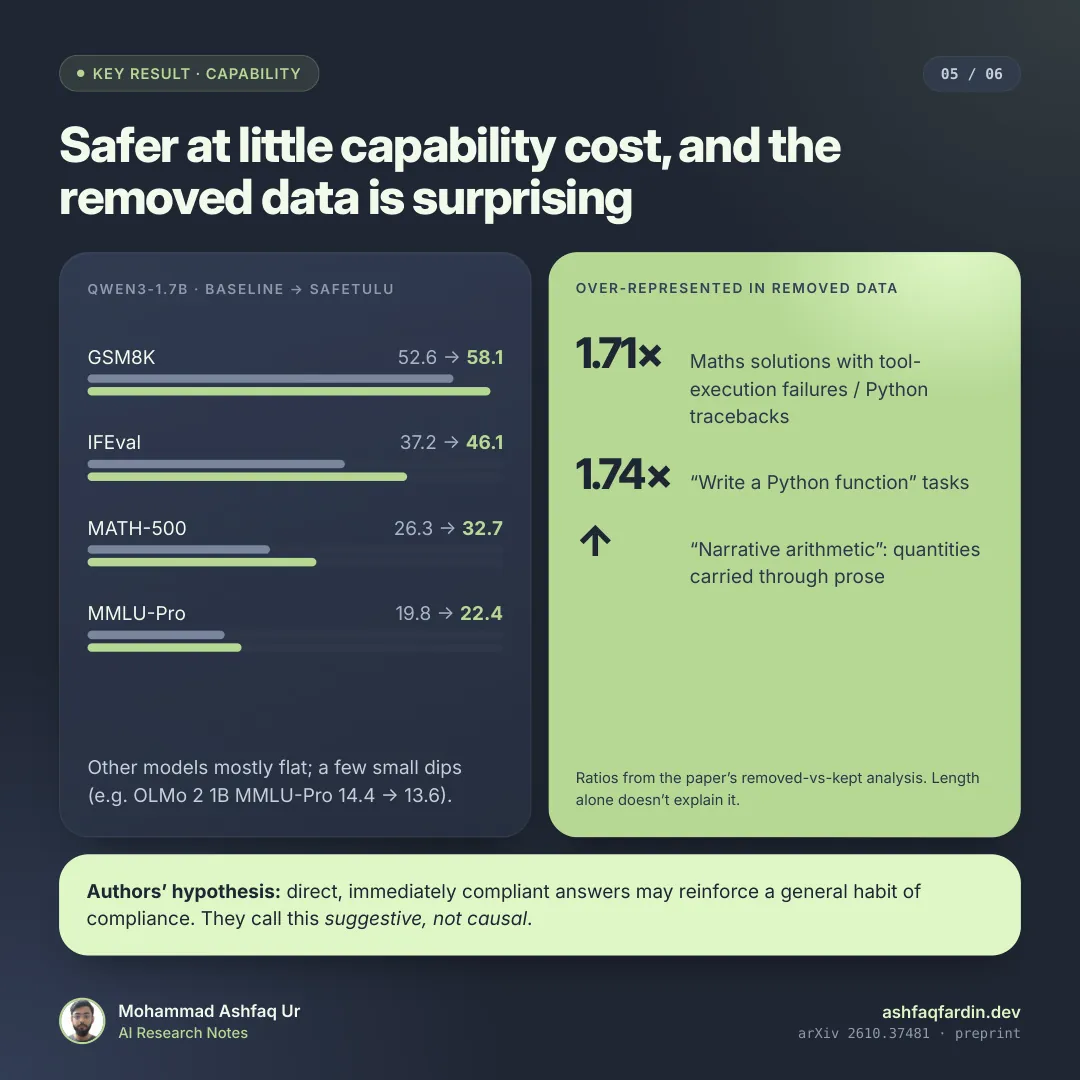
Slide 5 · KEY RESULT · CAPABILITY
Safer at little capability cost, and the removed data is surprising
QWEN3-1.7B · BASELINE → SAFETULU
GSM8K 52.6 → 58.1 IFEval 37.2 → 46.1 MATH-500 26.3 → 32.7 MMLU-Pro 19.8 → 22.4
Other models mostly flat; a few small dips (e.g. OLMo 2 1B MMLU-Pro 14.4 → 13.6).
OVER-REPRESENTED IN REMOVED DATA
1.71×
Maths solutions with tool- execution failures / Python tracebacks
1.74×
“Write a Python function” tasks
↑
“Narrative arithmetic”: quantities carried through prose
Ratios from the paper’s removed-vs-kept analysis. Length alone doesn’t explain it.
Authors’ hypothesis: direct, immediately compliant answers may reinforce a general habit of compliance. They call this suggestive, not causal.
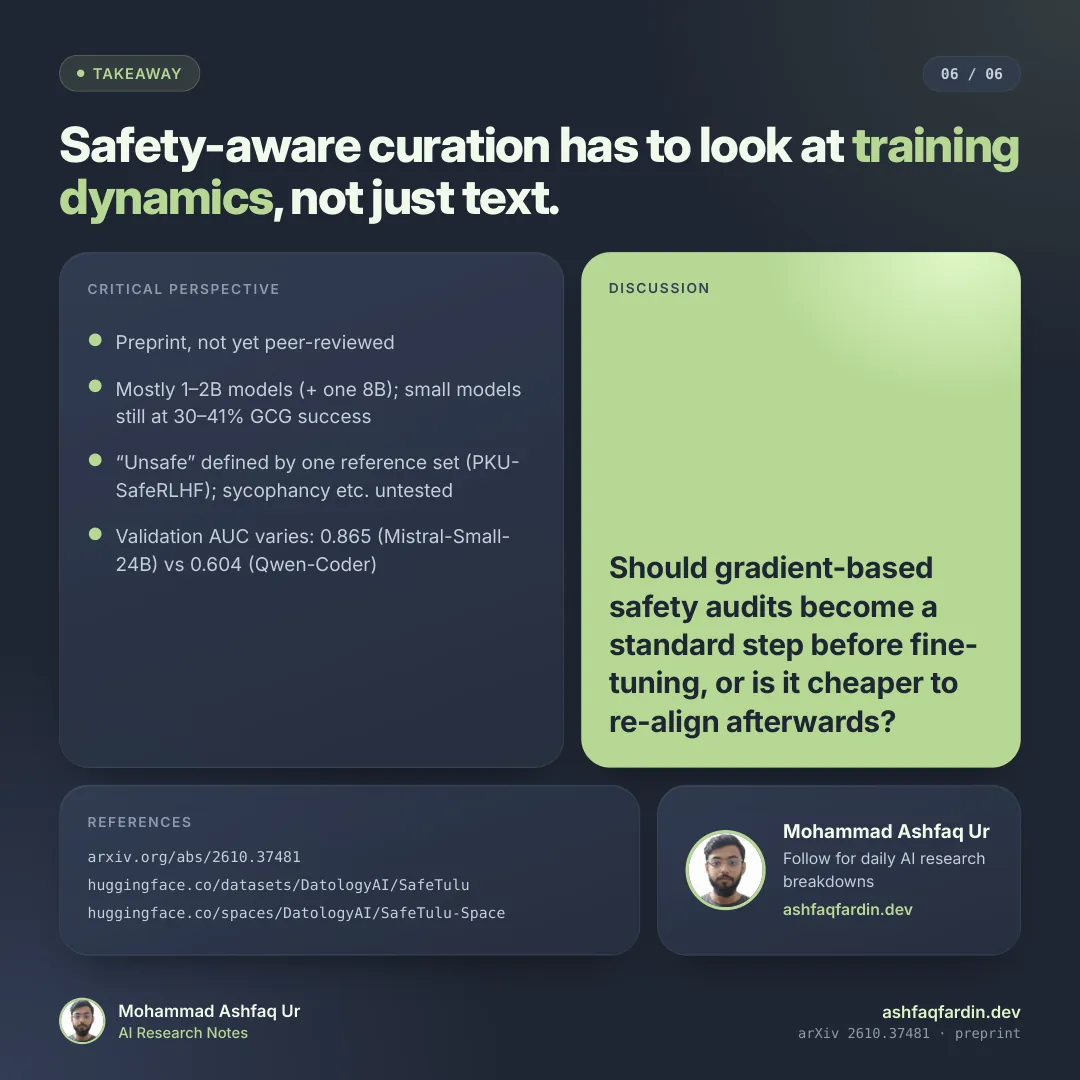
Slide 6 · TAKEAWAY
Safety-aware curation has to look at training dynamics, not just text.
CRITICAL PERSPECTIVE
- Preprint, not yet peer-reviewed
- Mostly 1–2B models (+ one 8B); small models still at 30–41% GCG success
- “Unsafe” defined by one reference set (PKU- SafeRLHF); sycophancy etc. untested
- Validation AUC varies: 0.865 (Mistral-Small- 24B) vs 0.604 (Qwen-Coder)
DISCUSSION
Should gradient-based safety audits become a standard step before fine- tuning, or is it cheaper to re-align afterwards?
REFERENCES
arxiv.org/abs/2610.37481
huggingface.co/datasets/DatologyAI/SafeTulu
huggingface.co/spaces/DatologyAI/SafeTulu-Space