LONG CONTEXTINTERPRETABILITY
Context rot isn’t about length. It’s a fight for attention.
Failure tracks how much attention is left on the evidence.

Read the slides as text 6 slides
Slide 1 · LONG CONTEXT · INTERPRETABILITY
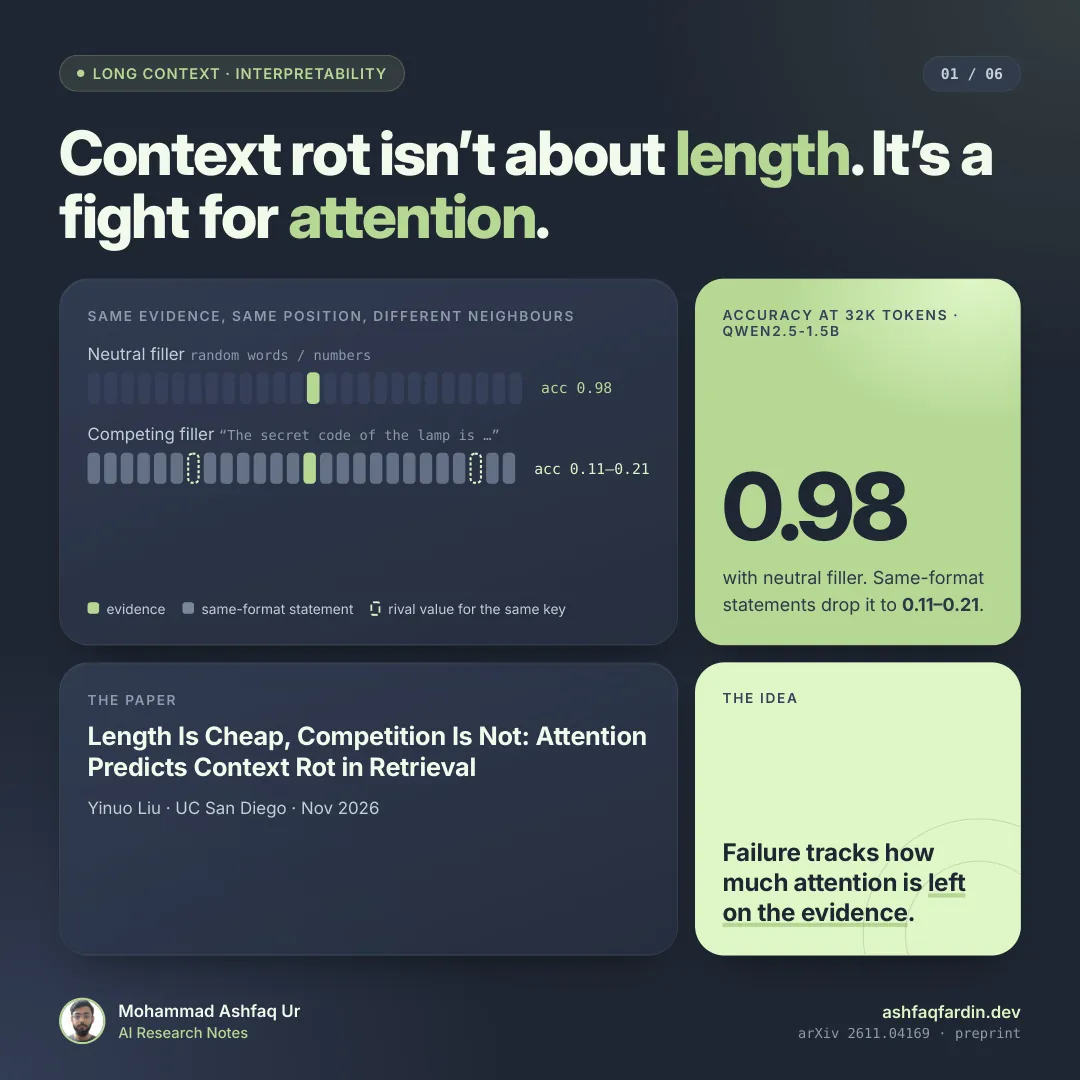
Context rot isn’t about length. It’s a fight for attention.
SAME EVIDENCE, SAME POSITION, DIFFERENT NEIGHBOURS
Neutral filler random words / numbers
acc 0.98
Competing filler “The secret code of the lamp is …”
acc 0.11–0.21 evidence
same-format statement
rival value for the same key
ACCURACY AT 32K TOKENS · QWEN2.5-1.5B
0.98
with neutral filler. Same-format statements drop it to 0.11–0.21.
THE PAPER
Length Is Cheap, Competition Is Not: Attention Predicts Context Rot in Retrieval
Yinuo Liu · UC San Diego · Nov 2026
THE IDEA
Failure tracks how much attention is left on the evidence.
Slide 2 · THE PROBLEM
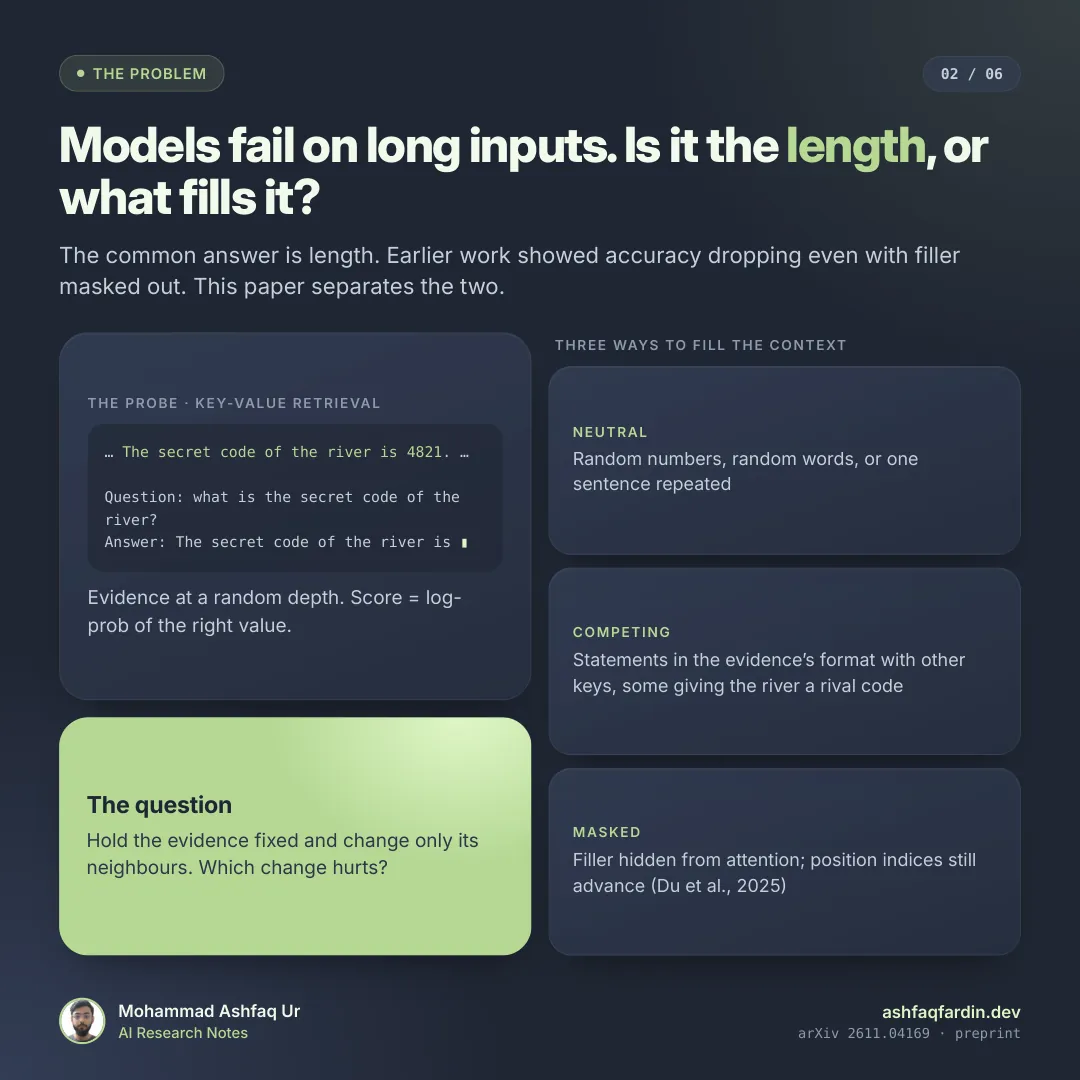
Models fail on long inputs. Is it the length, or what fills it?
The common answer is length. Earlier work showed accuracy dropping even with filler masked out. This paper separates the two.
THREE WAYS TO FILL THE CONTEXT
THE PROBE · KEY-VALUE RETRIEVAL
… The secret code of the river is 4821. …
Question: what is the secret code of the river? Answer: The secret code of the river is ▮
Evidence at a random depth. Score = log- prob of the right value.
The question
Hold the evidence fixed and change only its neighbours. Which change hurts?
NEUTRAL
Random numbers, random words, or one sentence repeated
COMPETING
Statements in the evidence’s format with other keys, some giving the river a rival code
MASKED
Filler hidden from attention; position indices still advance (Du et al., 2025)
Slide 3 · THE METHOD
Change only the neighbours, then look inside the model
1 Plant
One key-value fact at a random depth
2 Fill
Neutral, competing or masked filler, 512 to 32K tokens
3 Score
Loss Δ = log(p_short / p_filled), in nats
4 Read
Attention a* from the last token to the evidence
ATTENTION MASS A*
query evidence rivals
top-8 evidence heads
FIVE OPEN MODELS · FOUR FAMILIES
Qwen2.5-0.5B-Instruct
Qwen2.5-1.5B-Instruct
SmolLM2-1.7B-Instruct
OLMo-2-1B-Instruct
Llama-3.2-3B (base)
Plus Qwen2.5-7B for the MMLU replication.
SCALE
126,473
trial-level measurements, all released
Slide 4 · KEY RESULT · LENGTH
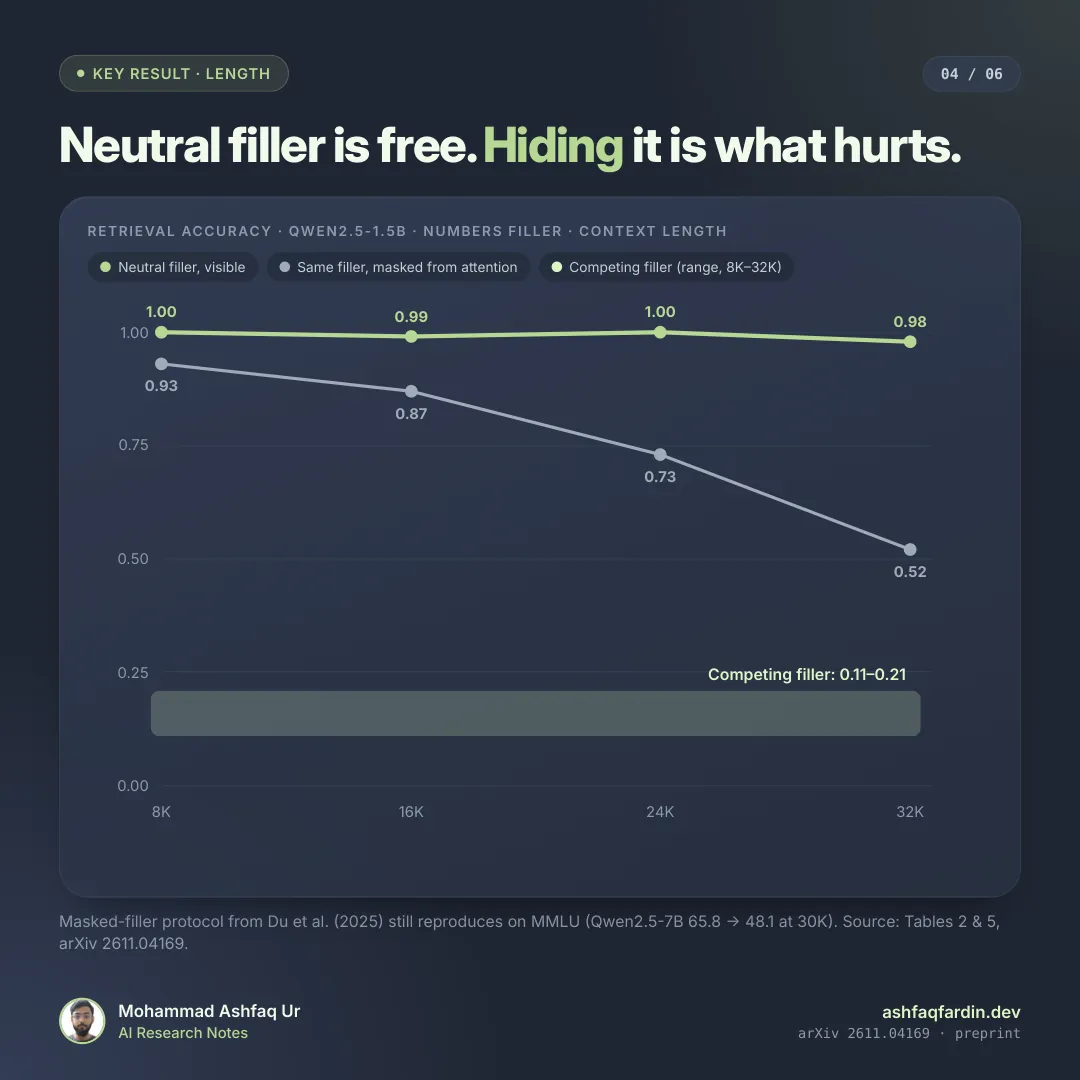
Neutral filler is free. Hiding it is what hurts.
Masked-filler protocol from Du et al. (2025) still reproduces on MMLU (Qwen2.5-7B 65.8 → 48.1 at 30K). Source: Tables 2 & 5, arXiv 2611.04169.
RETRIEVAL ACCURACY · QWEN2.5-1.5B · NUMBERS FILLER · CONTEXT LENGTH
Neutral filler, visible
Same filler, masked from attention
Competing filler (range, 8K–32K)
0.00 0.25 0.50 0.75 1.00
8K
16K
24K
32K
Competing filler: 0.11–0.21
0.93 0.87 0.73 0.52 1.00 0.99 1.00 0.98
Slide 5 · KEY RESULT · COMPETITION
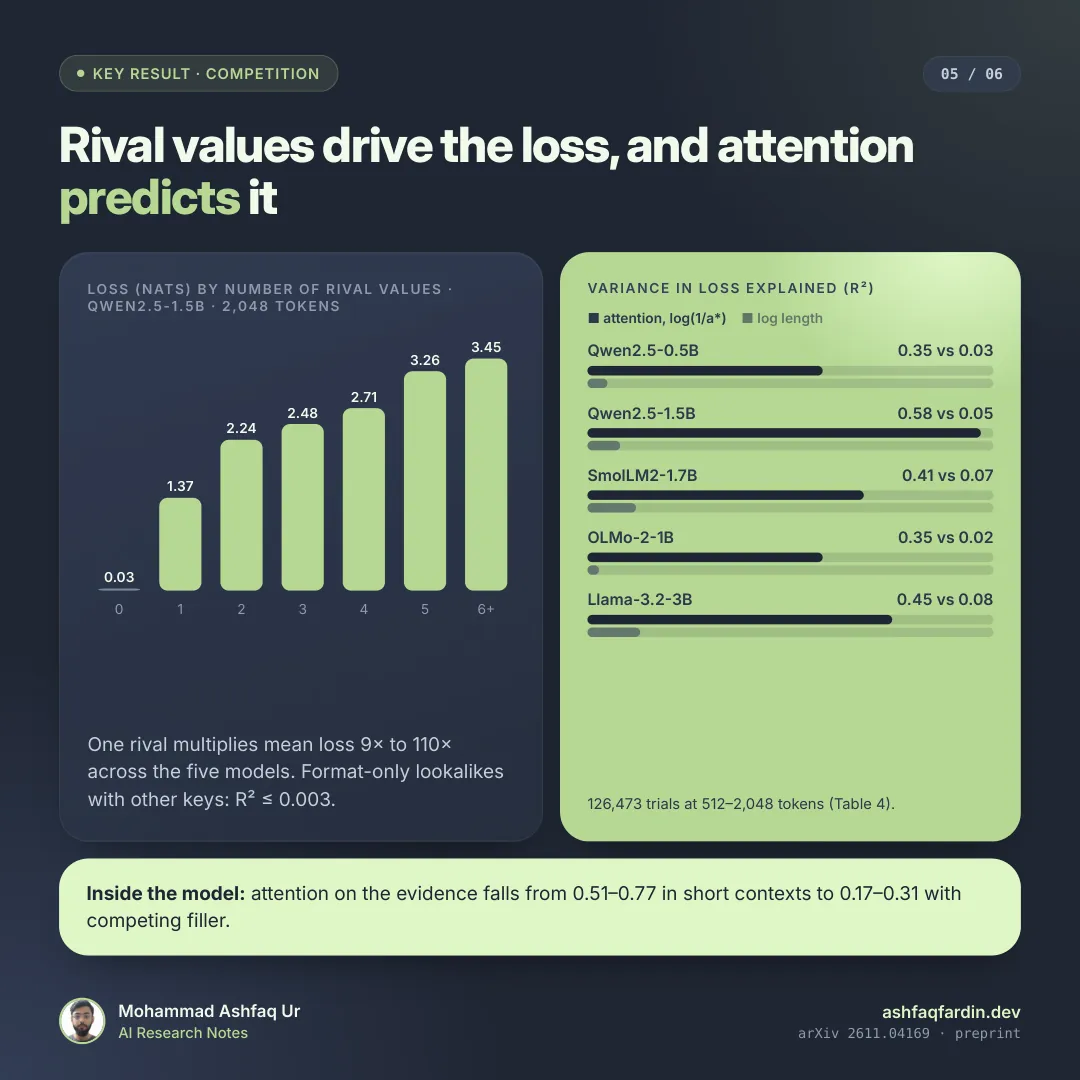
Rival values drive the loss, and attention predicts it
LOSS (NATS) BY NUMBER OF RIVAL VALUES · QWEN2.5-1.5B · 2,048 TOKENS
0.03 0 1.37 1 2.24 2 2.48 3 2.71 4 3.26 5 3.45 6+
One rival multiplies mean loss 9× to 110× across the five models. Format-only lookalikes with other keys: R² ≤ 0.003.
VARIANCE IN LOSS EXPLAINED (R²)
■ attention, log(1/a*)
Qwen2.5-0.5B 0.35 vs 0.03 Qwen2.5-1.5B 0.58 vs 0.05 SmolLM2-1.7B 0.41 vs 0.07 OLMo-2-1B 0.35 vs 0.02 Llama-3.2-3B 0.45 vs 0.08
126,473 trials at 512–2,048 tokens (Table 4).
■ log length
Inside the model: attention on the evidence falls from 0.51–0.77 in short contexts to 0.17–0.31 with competing filler.
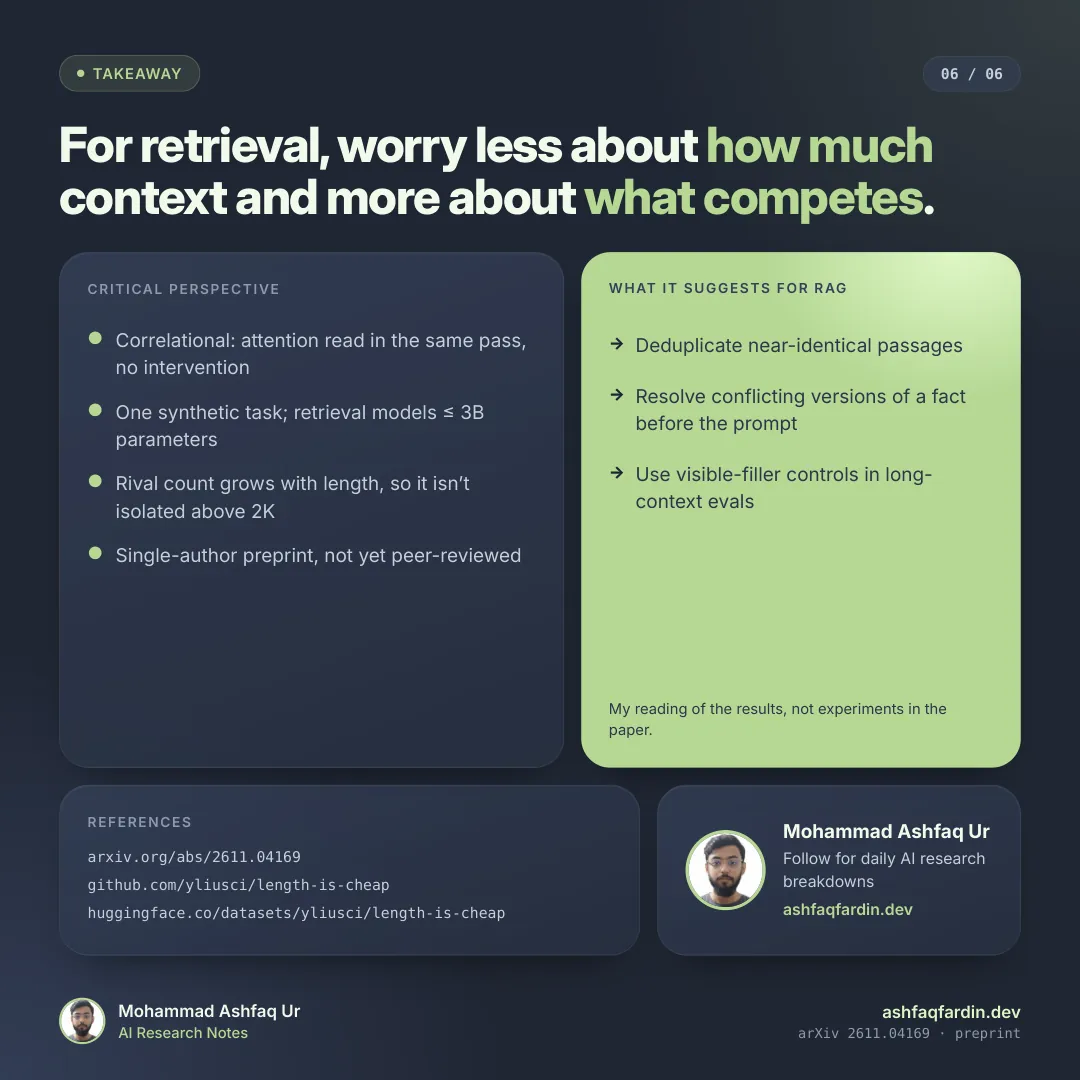
Slide 6 · TAKEAWAY
For retrieval, worry less about how much context and more about what competes.
CRITICAL PERSPECTIVE
- Correlational: attention read in the same pass, no intervention
- One synthetic task; retrieval models ≤ 3B parameters
- Rival count grows with length, so it isn’t isolated above 2K
- Single-author preprint, not yet peer-reviewed
WHAT IT SUGGESTS FOR RAG
→Deduplicate near-identical passages
→Resolve conflicting versions of a fact
before the prompt
→Use visible-filler controls in long-
context evals
My reading of the results, not experiments in the paper.
REFERENCES
arxiv.org/abs/2611.04169
github.com/yliusci/length-is-cheap
huggingface.co/datasets/yliusci/length-is-cheap