MODEL COMPRESSIONINTERPRETABILITY
Compression that is harmless in a small model can be costly in a large one.
Separate the damage from the network's repair.
Read the slides as text 6 slides
Slide 1 · MODEL COMPRESSION · INTERPRETABILITY
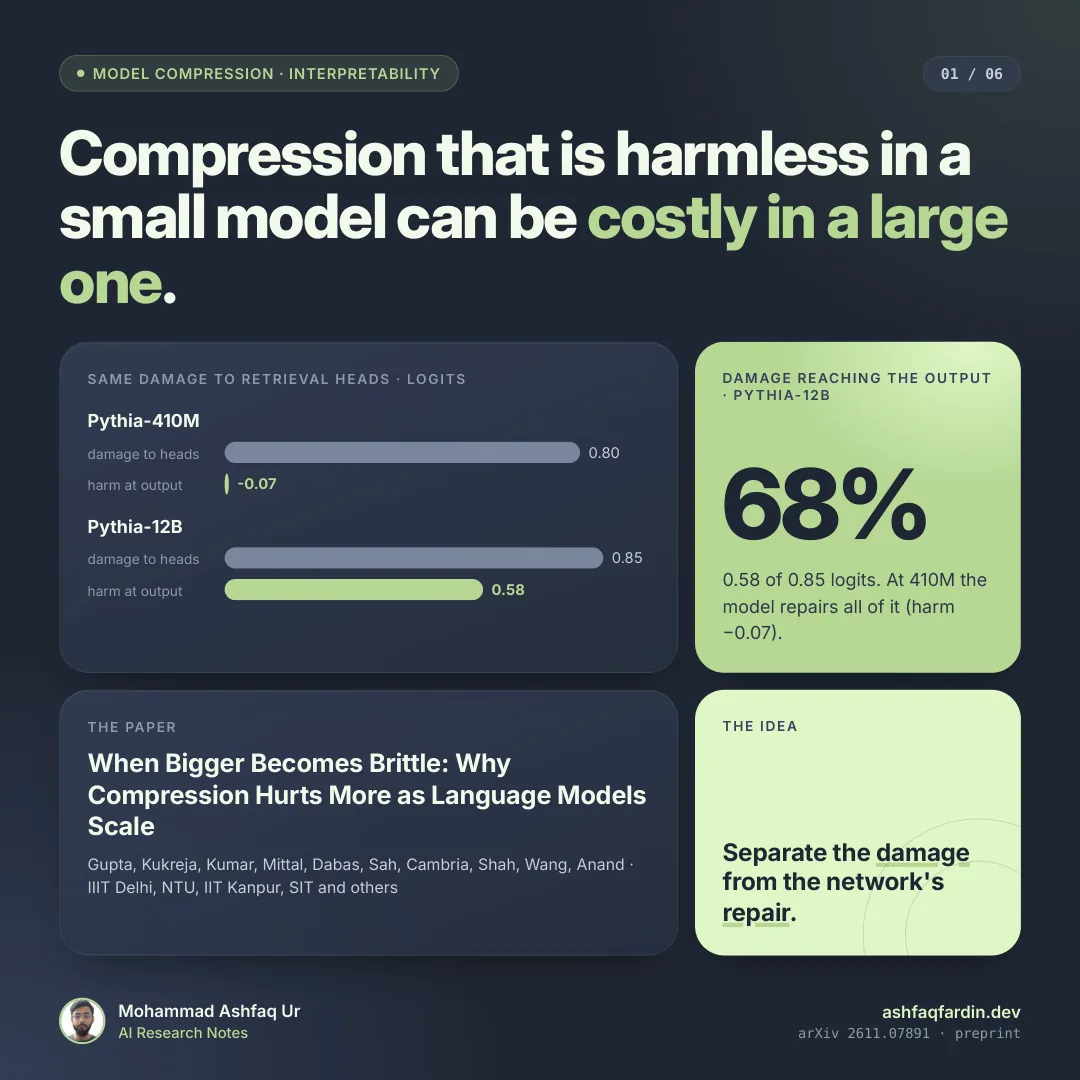
Compression that is harmless in a small model can be costly in a large one.
SAME DAMAGE TO RETRIEVAL HEADS · LOGITS
Pythia-410M
damage to heads
0.80 harm at output -0.07 Pythia-12B
damage to heads
0.85 harm at output 0.58
DAMAGE REACHING THE OUTPUT · PYTHIA-12B
68%
0.58 of 0.85 logits. At 410M the model repairs all of it (harm −0.07).
THE PAPER
When Bigger Becomes Brittle: Why Compression Hurts More as Language Models Scale
Gupta, Kukreja, Kumar, Mittal, Dabas, Sah, Cambria, Shah, Wang, Anand · IIIT Delhi, NTU, IIT Kanpur, SIT and others
THE IDEA
Separate the damage from the network's repair.
Slide 2 · THE PROBLEM
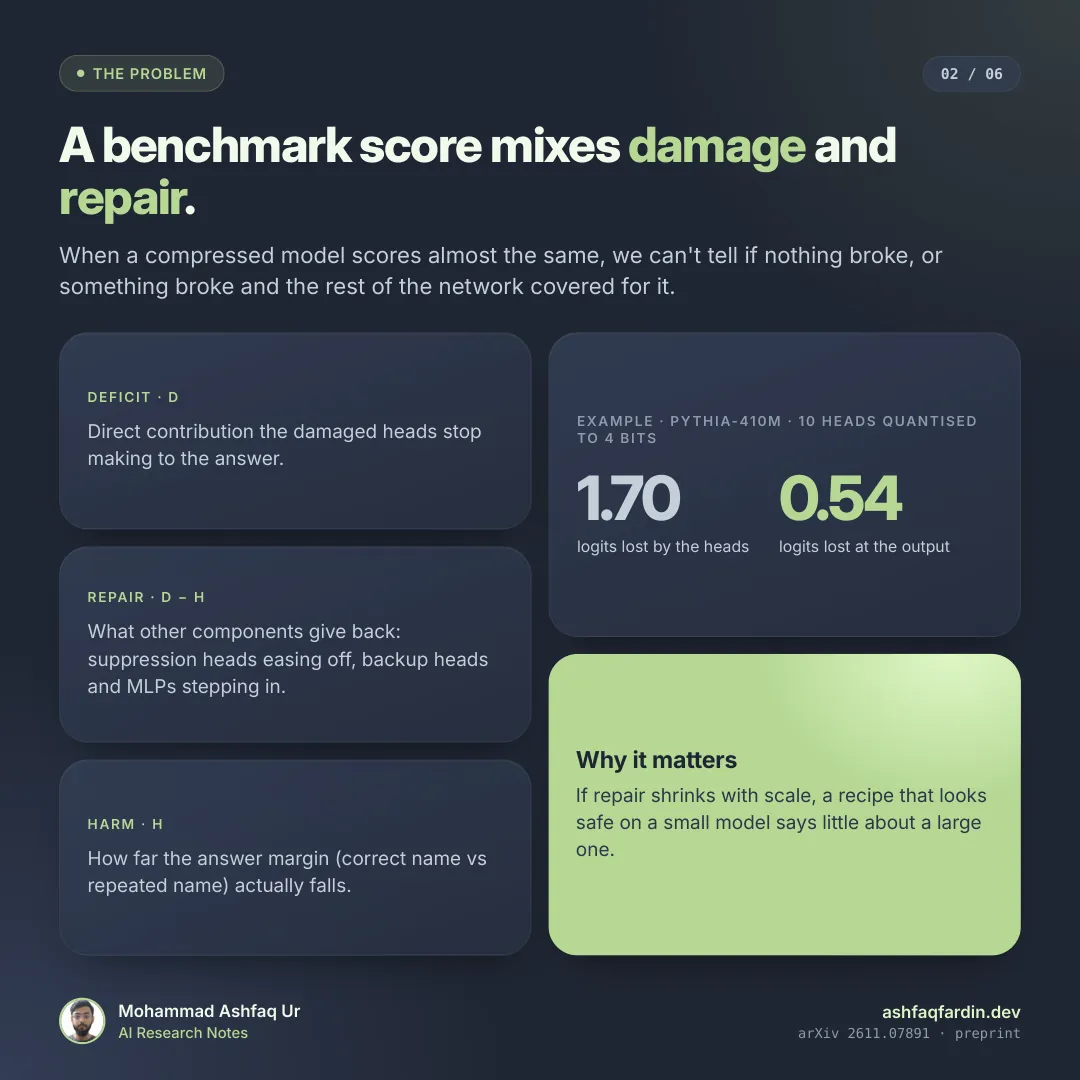
A benchmark score mixes damage and repair.
When a compressed model scores almost the same, we can't tell if nothing broke, or something broke and the rest of the network covered for it.
DEFICIT · D
Direct contribution the damaged heads stop making to the answer.
REPAIR · D − H
What other components give back: suppression heads easing off, backup heads and MLPs stepping in.
HARM · H
How far the answer margin (correct name vs repeated name) actually falls.
EXAMPLE · PYTHIA-410M · 10 HEADS QUANTISED TO 4 BITS
1.70
logits lost by the heads 0.54
logits lost at the output
Why it matters
If repair shrinks with scale, a recipe that looks safe on a small model says little about a large one.
Slide 3 · THE METHOD · LOGIT ACCOUNTING
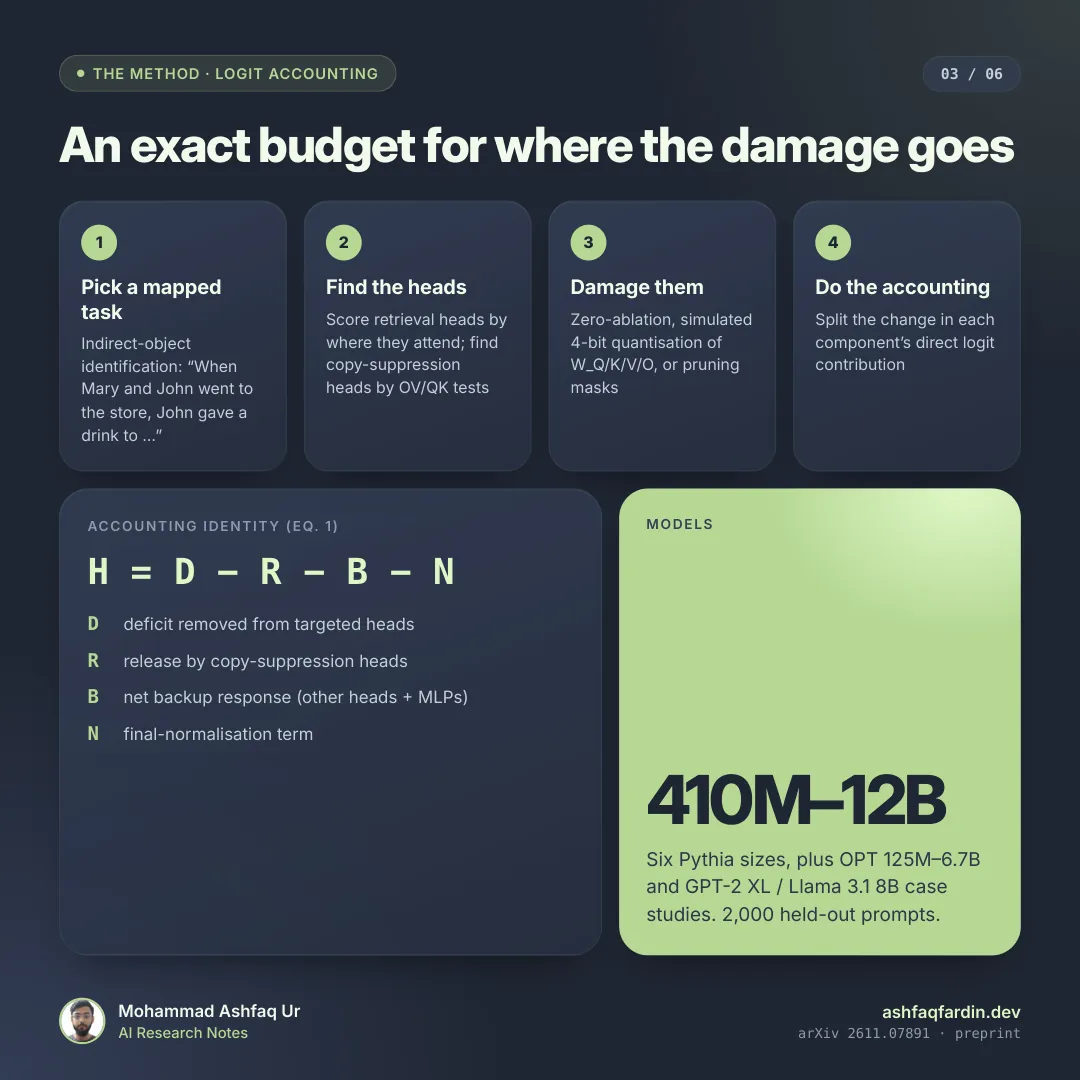
An exact budget for where the damage goes
1
Pick a mapped task
Indirect-object identification: “When Mary and John went to the store, John gave a drink to …”
2 Find the heads
Score retrieval heads by where they attend; find copy-suppression heads by OV/QK tests
3 Damage them
Zero-ablation, simulated 4-bit quantisation of W_Q/K/V/O, or pruning masks
4
Do the accounting
Split the change in each component’s direct logit contribution
ACCOUNTING IDENTITY (EQ. 1)
H = D − R − B − N
D
deficit removed from targeted heads
R
release by copy-suppression heads
B
net backup response (other heads + MLPs)
N
final-normalisation term
MODELS
410M–12B
Six Pythia sizes, plus OPT 125M–6.7B and GPT-2 XL / Llama 3.1 8B case studies. 2,000 held-out prompts.
Slide 4 · KEY RESULT · SCALING
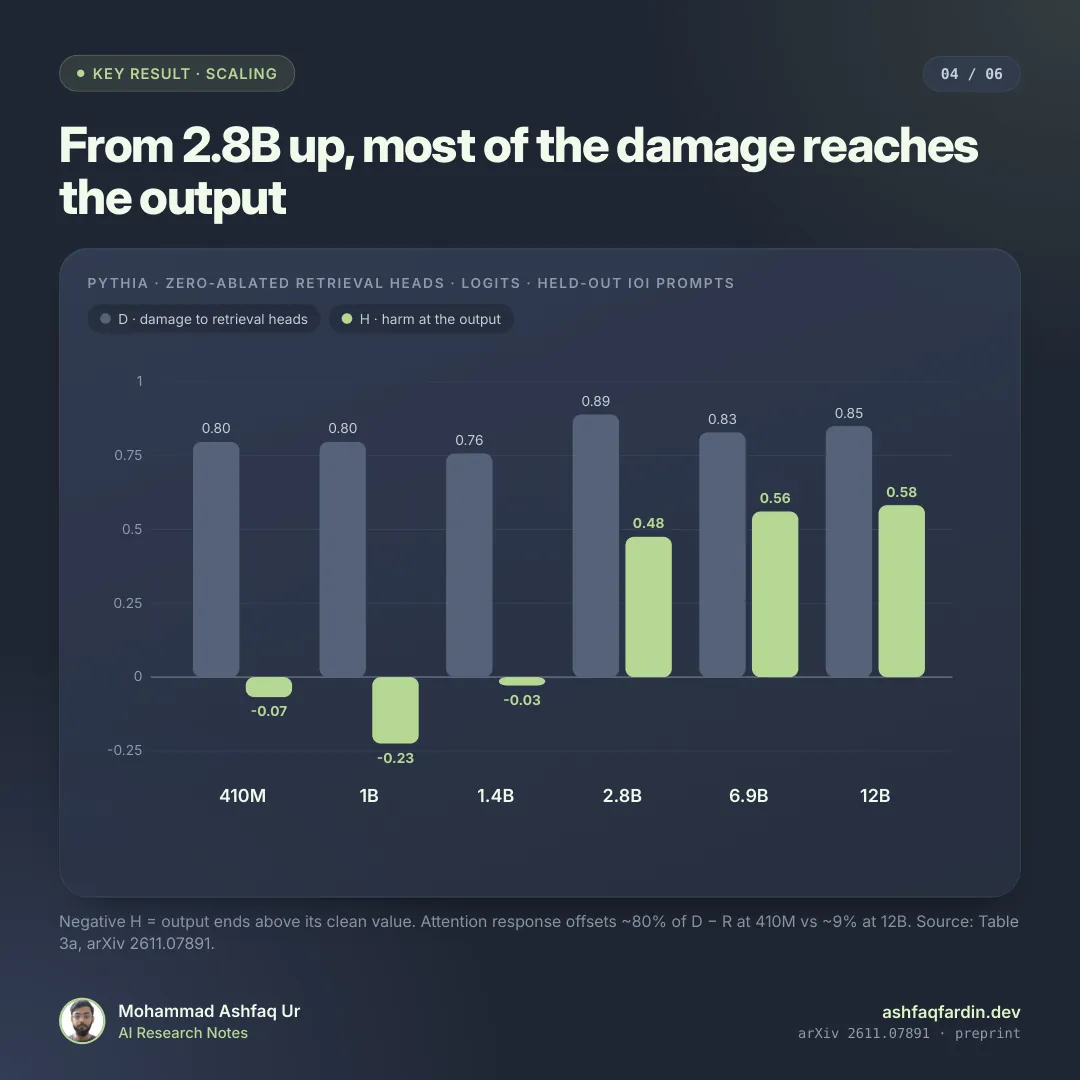
From 2.8B up, most of the damage reaches the output
Negative H = output ends above its clean value. Attention response offsets ~80% of D − R at 410M vs ~9% at 12B. Source: Table 3a, arXiv 2611.07891.
PYTHIA · ZERO-ABLATED RETRIEVAL HEADS · LOGITS · HELD-OUT IOI PROMPTS
D · damage to retrieval heads
H · harm at the output
-0.25 0 0.25 0.5 0.75 1 0.80 -0.07 410M 0.80 -0.23 1B 0.76 -0.03 1.4B 0.89 0.48 2.8B 0.83 0.56 6.9B 0.85 0.58 12B
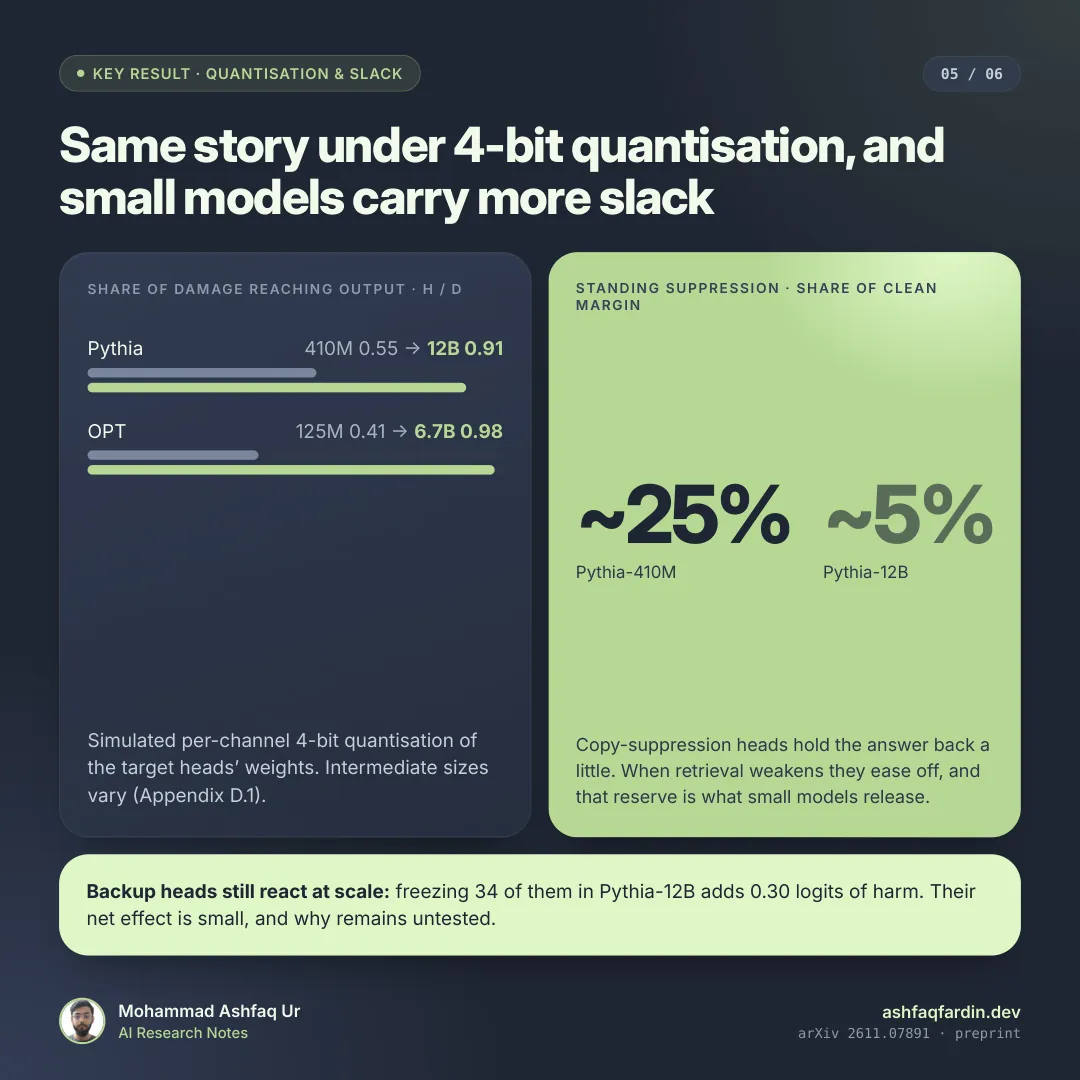
Slide 5 · KEY RESULT · QUANTISATION & SLACK
Same story under 4-bit quantisation, and small models carry more slack
SHARE OF DAMAGE REACHING OUTPUT · H / D
Pythia
410M 0.55 → 12B 0.91
OPT
125M 0.41 → 6.7B 0.98
Simulated per-channel 4-bit quantisation of the target heads’ weights. Intermediate sizes vary (Appendix D.1).
STANDING SUPPRESSION · SHARE OF CLEAN MARGIN
~25% Pythia-410M Pythia-12B
Copy-suppression heads hold the answer back a little. When retrieval weakens they ease off, and that reserve is what small models release.
~5%
Backup heads still react at scale: freezing 34 of them in Pythia-12B adds 0.30 logits of harm. Their net effect is small, and why remains untested.
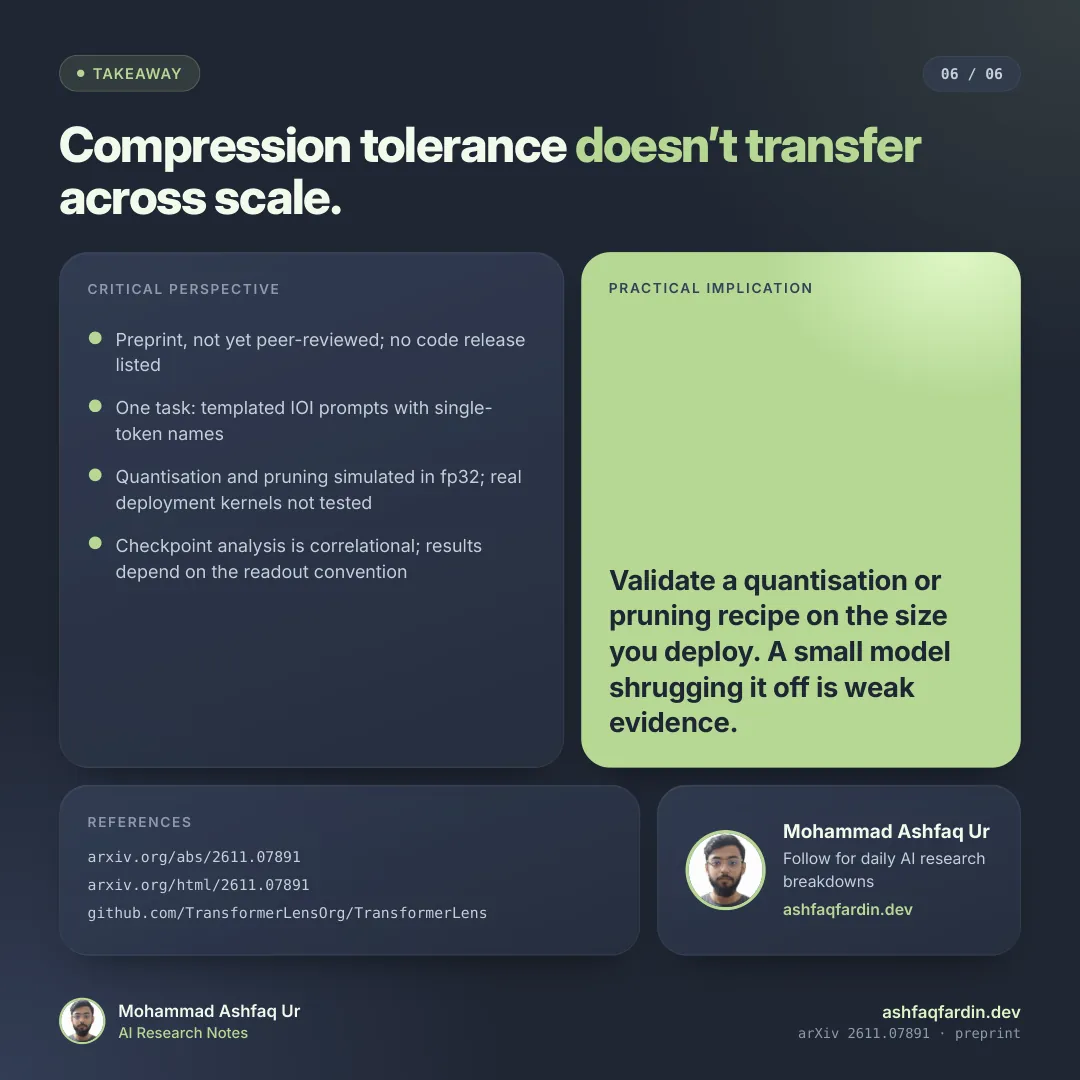
Slide 6 · TAKEAWAY
Compression tolerance doesn’t transfer across scale.
CRITICAL PERSPECTIVE
- Preprint, not yet peer-reviewed; no code release listed
- One task: templated IOI prompts with single- token names
- Quantisation and pruning simulated in fp32; real deployment kernels not tested
- Checkpoint analysis is correlational; results depend on the readout convention
PRACTICAL IMPLICATION
Validate a quantisation or pruning recipe on the size you deploy. A small model shrugging it off is weak evidence.
REFERENCES
arxiv.org/abs/2611.07891
arxiv.org/html/2611.07891
github.com/TransformerLensOrg/TransformerLens